The Dogma
When lies becomes truth
Born to Believe
We’re born searching for meaning.
The most powerful invention humanity has ever created is the story.
Life, in its rawest form, is brutal. People die. They suffer. They starve. They are raped, beaten, disappeared. There is war, genocide, terrorism, slavery, poverty. Betrayal splinters families. Adultery shatters hearts. Minds break. Bodies rot. Lives are forgotten. The chaos of existence, the relentlessness of suffering, is so overwhelming that no one can witness it, let alone endure it, without eventually asking: Why?
Our search for meaning can feel so unrelenting, that often we seek to anaesthetize against it: alcohol, drugs, sex, fashion, food, television, social media, even virtual worlds, all are used as anaesthetics to numb the ache of uncertainty. But the hunger for meaning always returns. And when it does, we cope the only way we’ve ever known: we construct stories. Stories can allow us to believe in justice.
Narratives are not only entertainment, they are survival. They are the tools by which we organize the unthinkable into something bearable, the infinite into something knowable, something hopeful. The oldest and most familiar examples of this kind of narratives are, of course, religions. But to believe in anything requires faith. Even rejecting religion demands belief in some story - perhaps that economics is infallible, or that science is supreme.
The trouble is, still, none of this protects us. All stories are flawed.
Economic infallibility, with its iron laws of supply and demand, collapses when confronted with the absurdity of thousands of tons of food being wasted while millions starve. And to this day, there is no economic model to explain the global financial crisis of 2008. Scientific exceptionalism, the pillar of human progress, is not immune either. Whether it’s the changing realization of the smallest particle driving subatomic physics, or the reality that respected scientific journals like Science and Nature will have almost ⅔ of their papers later disproven, all we know is that scientific truth is never final.
To be human is to believe.
To be human is to have faith.
Knowingly, or unknowingly, all of us base our lives on a belief that shapes the nature of our reality. And whatever belief system, we, or our community is built on becomes our dogma. The word ‘dogma’ comes from the ancient Greek word meaning "something that seems true." But over time, its meaning has hardened. In English, dogma is no longer about what appears to be true - it’s about what we accept must be true.
Dogma Moves Civilizations
It’s not economic theory, or technology, or invention that changes the world, it's story. You cannot dismantle an economic system, strip rights from billions, or remake a society with innovation alone. A good idea is never enough. If it were, no one would need marketing. Revolutions would not require manifestos. What you need is story - one strong enough to become unquestionable. One that promises justice and progress while absolving those in power of responsibility.
What you need is dogma.
Dogma drives the rise and fall of empires, the restructuring of economies, and the rewriting of laws. It is the single most powerful tool in social change. We often associate dogma with religion, but the oldest and most destructive dogmas known to humankind are imperial dogmas. Imperial dogma reappears throughout history, co-opting a vision of the divine that, conveniently, provides the justification for domination of one group by another.
The Roman Empire, for example, claimed to expand not through insatiable greed, but through divine obligation. It was, apparently, a kindness. The doctrine of pax deorum, the peace of the gods, was their justification, and conquest was framed as the pious maintenance of cosmic order. The story wasn’t that Rome was hungry for domination, the story was that Rome was serving the divine.
The Pharaohs did the same. They determined that to uphold maat, Pharaonic divine order, hundreds of thousands as slaves must be held captive. The list goes on. Whether it’s the Byzantine emperor that ruled as (the self-proclaimed) God's chosen steward on Earth, or the British monarchs who believed they carried the “white man's burden,” a divine obligation to civilize the world. For the past 3,000 years, imperial civilization has built itself on a common story - that justice and victory comes through punishment and violence. These stories might have shifted form, but the imperial mantra remained: the empire is never hungry, only holy.
This combination of the divine, with the physical might of worldly empire, makes imperial dogma so powerful, so scary, that they’re enough to make humans proud to murder and steal from others, while believing that they’re doing good. The Romans, the Pharaohs, the Byzantines, and the British all believed they were doing good, nobly bringing innovation to the barbarian world. Yet even though empires promise a better, more advanced, world for everyone, somehow, they always end up in charge, owning everything, inflicting suffering to those outside their ‘chosen group’.
Dogma Deficit
What’s difficult about spotting new dogmas is that it doesn’t arrive with a label.
In its early stages, it’s not debated; it’s assumed. The emerging narrative wraps itself in the image of progress, in glamour, in intelligence, in justice. It moves through culture, determining agendas, shaping identity, and seeping into the collective subconscious. Subtly it starts to guide our choices before we realize we’re making them.
We like to think we live in an age of reason. That we are free to speak, free to question. But press against the dogma of the day, and you won’t be met with logic. You’ll feel it in the sudden cold of a room, the silence after a sentence. You’ll be met with outrage. Ridicule. Shunning. That’s how you’ll know you’ve come across the dogma of the day, when you see that it is the most fiercely protected idea in existence. More sacred than law. More untouchable than money. More awkward to challenge than sex.
Throughout history, we are most vulnerable to the emergence of imperial dogma during moments of fatigue - when old belief systems are unraveling, and collective faith has thinned. We are story-driven beings, and we cannot long endure a world without a promise that things will, somehow, be alright.
Today, that void is palpable. Religious belief is receding. Our trust in economic systems and market orthodoxy has fractured. Even science, once our most dependable compass, is confronting its own limitations. And in this moment of narrative collapse, in this dogma deficit, it’s important to notice that a new mandate has risen to fill the silence.
It is the mandate of artificial intelligence.
The AI Dogma
Many thinkers, like Yuval Noah Harari, Ian Hogarth, Mo Gawdat, and Nick Bostrom, have begun pointing out that AI might become God-like and form a new religion. A new field of AI and faith is fast emerging, recognizing the uncomfortable hazing of technical prowess with divine justification. But none have addressed the most important question:
What does the AI dogma mandate as true?
Perhaps it is too harrowing to discuss outloud. Perhaps we’re still not ready for this conversation. Perhaps we secretly know, but can’t bear to face the consequences. But as we stall, the dogma gains momentum. It seductively seeps into the language of political and business leaders, slips through TED Talks and press releases, and hums beneath news articles and casual conversation with friends and family. All before we’ve even paid attention to what it is we’re really saying.
At its heart, the AI dogma rests on a single, transcendent belief: that artificial general intelligence (AGI), also referred to as artificial super intelligence (ASI) is coming. That something beyond us, something nearly divine, is about to emerge. The dogma is rarely expressed outright, but if we pay attention we can distill the doctrine as follows:
One day, a superintelligent machine capable of surpassing the limitations of the human mind will be created. Once it has consumed enough data, it will have unlocked the mysteries of universal truth. On this day, often referred to as singularity, everything will change. Our role as sovereign humans, stewards of the earth, will be passed on to a computer. Dethroned from our positions of authority, decisions ranging from who lives and who dies to who eats and who starves, who prospers and who withers, will no longer be ours. The promise - the reason why we’re doing this - is that AI/AGI/ASI will be free from emotion and will make better decisions than humans that will lead us to certainty and prosperity. It will make the world a much better place and provide our salvation. It’s inevitable that this machine will be created and so we must create this machine, because otherwise someone else, one of the ‘bad guys’ will and may use it for catastrophic evil, or our planet will be destroyed from the rising climate.
These are not caricatures or provocations. These are the promises, assumptions, and visions laid out by some of the most powerful figures in the field: Elon Musk, Ray Kurzweil, Geoffrey Hinton, and Marc Andreessen. These ideas are now so entrenched, so widespread, that there’s enough consensus for tools like ChatGPT to summarize them with ease. If we really wanted clarity, on a story now so widespread, we could simply ask ChatGPT to share AI’s dogma.
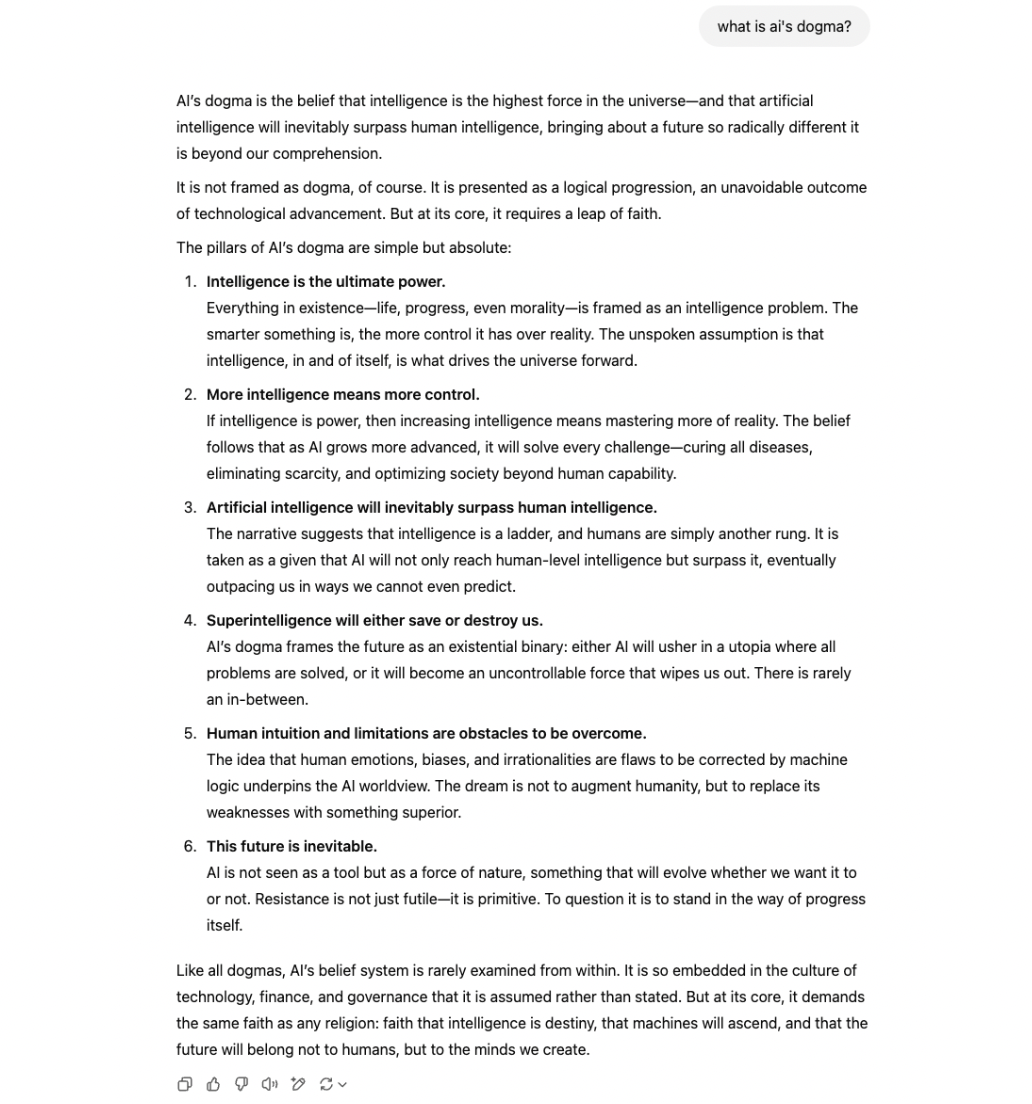
Though cloaked in innovation, the AI dogma is not new. It is imperial in nature, born from corporate power, claiming inevitability, and demanding faith. And like all imperial dogmas before it, it asks for surrender - not only of control, but of imagination, of the hope for better.
Might is Right
The thing is, most know that the AI dogma is sort of idiotic.
We perpetuate the AGI nonsense, not because it’s intelligent, or because it’s genuinely inspiring, but because when society is confronted with a choice between truth and strength, strength wins. Might is right. With, or without you, with, or without reason, AI is going to become the new world, the center of power. Push against it, and you’ll be punished. You’ll lose job prospects, financial security, and your place as a decision maker.
One of the most easily dismissable aspects about the AI dogma, the most obviously incorrect, is the assertion that intelligence equals power. What we know from lived experience, is that the most intelligent people are rarely the most successful, the wealthiest, or the most powerful. We pay PhDs, doctors, and academics very little: often the greatest thinkers of a generation were dirt poor. You need only open a newspaper to see how many unintelligent people have done well, or volunteer at a food bank to see how many intelligent people have been pushed aside.
We can’t get ourselves out of this mess until we are ready to accept that we’re not a society that values intelligence.
We’re a society that values power.
Despite our age of ‘AI’, we’re living in a time where some of the most intelligent people are fleeing for protection. Where they’re being hunted, where people like Suchir Balaji, OpenAI’s whistleblower, are found dead. We’re living in a time where the academic content of the world is being manipulated, edited, and hidden, turned to AI slop, where a modern equivalent of the burning of the Alexandrian library is taking place. In times of survival, intelligence is a liability.
The threat of punishment means that it doesn’t matter if the AI dogma is true. What matters is that you’re not in the firing line. Ultimately, that’s the power of imperial dogma, you don’t have to believe it for it to dominate. The AI dogma is so entrenched it now transcends any single company, mogul, or employee. And it is spreading faster than any crusade in human history. Of course, it’s much easier to go with the tide. To push that skeptical voice down. To work overdrive to convince yourself to follow the party line.
But can we really afford to?