AGI is Abrahamic
When an innovation story arrives cloaked in divine drama, in exile and apocalypse, in judgment and redemption, with the promise of salvation, we’re in familiar waters.
In the Beginning
There’s an idea going around that we’re on the cusp of creating superintelligence, or artificial general intelligence as some call it. The idea is that eventually we’ll build a machine powerful enough to unlock the fundamental codes of the universe, and once that happens, the machine will become sovereign, overpowering us all. What follows, whether tremendous progress or absolute catastrophe, remains uncertain.
What we are told, though, is that this future is inevitable.
It’s hard not to notice that this story seems to stir something deep within us, pulling on inferences of assumed power, provoking an almost ancient panic that feels older than language. It presses on old wounds and half-forgotten fears, the ones that make us tremble, thinking about vengeful forces greater than ourselves. We find ourselves reaching for any promise of safety, trying to secure a place in whatever new order might arrive. In that anxious grasping we cannot see the obvious.
This story isn’t new.
It’s biblical.
All emerging belief systems may seem revolutionary at the time, but more often than not, they simply repeat the past. It’s said that there are only seven stories in the world, and there is a reason that idea persists. There are only a certain number of stories that can trigger enough unconscious assumptions to be powerful. And there is no story that has influenced Western civilization more than that of Genesis.
Whether it’s the Handmaid's Tale, Children of Men, I Am Legend, East of Eden, Paradise Lost, The Road, Madonna, Lana Del Rey, the intro to Desperate Housewives, Joop!'s "All About Eve" perfume, or the phrase "can't tell him from Adam" - the Genesis story is part of our culture’s fabric. And, when you look more closely at the AGI narrative and its implicit assumptions, it becomes clear that the promise of superintelligence is really just a retelling of Genesis.
One God
The superintelligence narrative claims that intelligence is the ultimate power, and that everything can, with the right compute, be known and coherently articulated. Another way to put this is:
There is a single design behind the universe, knowable by ultimate intelligence.
The story does not define ‘intelligence’, or mention how this reconciles with modern scientific principles, like rationality, chaos theory, randomness, inconsistency, dark matter, and even nothingness. Instead, the story calls for faith in a single, unified truth running through the cosmos, sitting there, waiting to be discovered.
It is striking that there is no real, describable, pathway to AGI. There is no technical roadmap. No actual invention to point to. There is no explanation as to why exponential growth will, miraculously, not hit the mathematical limits of asymptotics. There is simply the expectation of intervention.
This is remarkably similar to the central lesson of the creation stories in the Book of Genesis, the opening of the Abrahamic religions. Aside from including stories that are scientifically curious, the book includes two distinct, contradictory, creation accounts, one where God creates the cosmos in seven days, another where God shapes mankind from dust. These two serve a singular purpose: to begin the sacred text by declaring that behind all things lies One intelligence, God. We can summarize the core lesson as:
There is a single design behind the universe, it is the ultimate intelligence, and that is God.
Both AGI and Genesis are monotheistic faith based stories.
Original Sin
In the superintelligence story humans are inherently flawed. We’re told that humans are limited by physical and emotional needs, the definitive obstacle to ultimate intelligence. Eventually though, we’re also told that humans will themselves create machines capable of surpassing human flaw, establishing a new order. In other words:
The human body disconnects us from ultimate intelligence.
In the AI narrative, the root of human suffering is not injustice, or scarcity, but the emotional reality of embodiment itself. The problem is in our physical bodies. That’s the thing to be solved. There is no room for valuing the senses, for vulnerability, for touch. The story hinges on the belief that if we could free our minds from the limits of the physical, we might finally attain perfect knowledge.
It’s only through submitting to technology, we’re told, that we can finally escape the dirty shame of the body, unite with the One Truth, and return humanity to righteousness. We forget how Puritan American commerce is until we remind ourselves of today’s rhetoric. Expelled from Europe for their severe disgust of the body, the Puritans sailed to America on the Mayflower, spreading the story of original, inescapable sin. And even to this day, whether it’s religion, science, commerce, food, drugs, recreation - or AI - the seeds of this belief are so ingrained that the West has yet to imagine a future in which we don’t punish our bodies.
We have, apparently, never sufficiently atoned for Eve.
In the Genesis story of Adam and Eve, we see the first explanation of our body’s original sin. God gives the first two humans a single command: do not eat from the Tree of Knowledge. But when the serpent tempts them with the promise of divine insight, they eat, and they are expelled from paradise. As punishment, they notice their nakedness, that the body is exposed, fallible, and mortal. Now life in physical form is punishment. Their bodies become not a vessel of divinity, but a symbol of exile. We could summarize it as:
The human body limits mankind from experiencing ultimate intelligence.
Both AGI and Genesis frame flesh as failure.
Judgement Day
The big AGI spectacular ends with an existential binary. Either AGI will establish utopia or become an uncontrollable force that wipes us out. What each of these have in common is the assumption that machine intelligence will become all powerful and determine humanity’s fate. Another way to say this would be:
When ultimate intelligence is achieved, humanity will be judged.
The promise of the technology lies not in what it knows, but in what it will do. Its allure rests on the hope that it will act as a pure, rational judge, untainted by bias, capable of imposing order on a chaotic and unjust world.
Any reference to Judgement Day, no matter how subtle, invokes the unsaid fear of cosmicide, sparking apocalyptic hysteria. We underestimate how powerful this conundrum is. According to the Pew Research Center, nearly 40% of Americans believe we are living in the ‘end times’. That figure doesn’t just reflect private belief - it reveals a national mindset, a culture steeped in anxiety that the end is always just around the corner.
As James Crossan notes in God and Empire, the source of our anxiety goes back to Genesis. When reminded of Judgement Day it provokes a question that, collectively, we have never truly answered but have long feared: in the final reckoning between good and evil, will a divine being choose compassion or punishment?
This is the great unresolved finale of Genesis. The story of Noah’s Ark is often told to children with illustrations of smiling animals boarding a boat two-by-two, but behind the giraffes and doves is a harrowing tale of divine judgment. In this story, God, disgusted at humanity, decides to drown the species, sparing only Noah’s family and a remnant of animal life. But then we get a different story. Eventually, after the flood, God makes a peaceful covenant with Noah, and later, with Noah’s descendant Abraham. Peace and harmony is restored. With these two accounts, all we know is that when God acts, whether in wrath, or in mercy, the world changes. We can summarize this as:
When ultimate intelligence appears on earth, humanity will be judged.
Both AGI and Genesis threaten a judgement day for humanity.
Abrahamic IP
The story of AGI is just Genesis, rewritten in techno-futurist language. The birth of a higher intelligence, the fall of man, the coming judgment, it isn’t new, it’s stolen Abrahamic IP. Only, the AGI version is a kind of Genesis glitch, stripped of its context, its nuance, and, most importantly, its redemption arc.
Like anything that machine learning steals, it cannot understand it. It does not have context. There is no prospect for redemption in the AI dogma. You get the drama of Genesis, the fear of apocalypse, but none of the other books. You don’t even get the whole of Genesis, just the first part, the primeval history, Chapters 1-11, the most vengeful part. No prophets. No poetry. No grace.
Yes, the AGI story co-opts the creation stories, Adam and Eve’s disobedience, the stories of violent fratricide, Cain and Abel, of utter destruction, the flood and Noah’s ark, and violent endings of the Tower of Babel. But then it stops. It stops right there. It cuts out before the stories of God’s covenant with humanity and God’s compassion emerge. The later stories of the covenant, of peace, and salvation, where humans reconcile with God and obtain a special relationship, are all discarded.
The problem isn’t that AGI orators have knowingly, or unknowingly, copied Genesis. Afterall, so many modern stories do. The problem is that they have chosen to truncate Genesis, only taking the primeval history that portrays God as maleficent, insecure, avenging, and unforgiving.
AGI only imagines divine violence.
We’re bombarded with stories about how AGI could cause extreme destruction. Superintelligence might solve climate change by murdering a billion people, it could end corruption by collapsing the global economy, or torture dissenters through surveillance and engineered suffering. It could even be born with a fondness for nuclear weapons. But when it comes to peace, it’s only silence. Intuitively, this omission petrifies us.
When we understand that the power of the AGI story comes, not from technology, but from religious iconography, we can begin to see what is actually causing our anxiety about the future more clearly. The seemingly unknowable superintelligence is really just the Abrahamic God, but with fewer features.
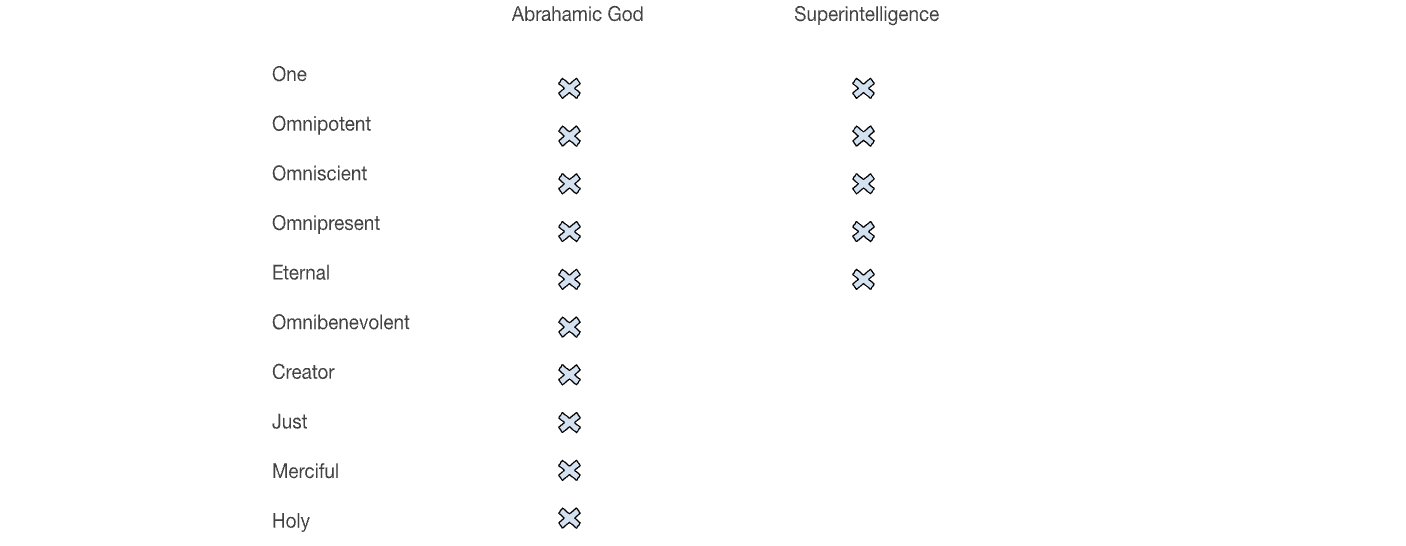
Agianity
Once you see the Genesis blueprint, you can’t unsee it. When you look at titans like Mark Zuckerberg, Jeff Bezos, Sam Altman, and their billionaire friends, who build elaborate doomsday bunkers to be ready for collapse, you see they truly believe they are modern day Noahs. They believe that AI will trigger an event where only their few will survive, and that they will be the ‘chosen ones’ to begin the human race anew.
When Elon Musk insists that humanity’s flaws will be so great, our only hope for survival is to live on Mars, he is telling us that humanity will be cast out of Eden, forced to abandon Earth, a lush, fragile, planet for the harsh, red, hell-like wasteland of Mars. We are promised a new world, where Musk will invent oceans, plants, livestock, and human-esque robots, coincidentally positioning him as the ultimate creator.
And of course, when Peter Theil can't stop talking about the imminent return of the Anti-Christ, his desperate desire for cosmic catastrophe comes out for all to see.
Can we wake up now?
These are religious extremists.
They are selling Judeo-Christian fragments of divine salvation to unsuspecting atheists, positioning it as science.
It’s hard not to notice that we are living through a moment in history in which traditionally religious people, most strikingly Pope Francis himself, are calling for reason, due process, and critical thinking, and while scientific and technological figures, like Demis Hassabis, are calling for, and demanding, faith. Any attempt to have a serious discussion about AGI’s religious underpinning is increasingly met with emotional hysteria and reactive extremism.
We are living through an ideological crusade.
A battle of God-against-god.
All we know is that AGI does not exist and that there is no way under the laws of mathematics that it can. When we’re asked to believe in it, anyway, when we’re asked to believe a miracle will somehow appear as revelation, AGI is presented as a competitor to God. What’s insidious about this, is that you cannot believe in both. Before you know it, you’ve converted.
AGI has taken on the structure of a competitive religious belief vying for world domination, using the language of engineering and computation to present itself as the higher power that will decide the fate of every person on earth. Preachers tell us that they won't stop, they can’t stop until the AGI-god wins. Until the entire globe surrenders to it. All because they insist a mechanical Messiah is the only hope of salvation.
In the name of secular technology we encourage this medieval rhetoric. There is now no opting out, no freedom of choice, no dignity. It’s forced conversion only. Reject the AI-god and you face consequences: unemployment, financial penalties, reduced access to public services, restricted education, and social exclusion.
For all our progress, we’re becoming religious again.